
March 2026

Data centers will come to Kentucky; EKPC is prepared
By Don Mosier
Kentucky finds itself at the heart of the next revolution of the Information Age. Data centers are coming. East Kentucky Power Cooperative (EKPC) is ready.
Because of their role in digital computing, data centers are as vital to our nation’s economy as factories, stores and office buildings. They will create new jobs, provide new investment in Kentucky’s communities, and generate tax revenue to support schools, roads, and other basic services. They will provide opportunities for Kentucky communities, many of which need a boost.
Due to their energy needs and operating characteristics, they will make significant contributions to cooperatives’ fixed costs and bottom line, helping to ease growing pressures on electric rates. A recent study by Lawrence Berkeley National Laboratory found large loads like data centers can actually help to lower electricity prices for other homes and businesses.
EKPC and our 16 owner-members are prepared to do our part to power data centers. Several years ago, we recognized the potential costs and risks—as well as the tremendous opportunities—presented by data centers to the communities and 1.1 million people we serve. We must be ready because we are required by law to serve any home or business that chooses to locate in our service territories.
Any new data centers sited in territories served by EKPC’s owner-member cooperatives will pay their own way. They will not pass along their costs to, or raise the rates paid by, our owner-members. EKPC has established rules that require data centers to pay for any new needed power plants and transmission infrastructure. These additional facilities will help build a stronger electric grid.
Data centers will pay the costs of those electric upgrades necessary to serve them, and other cooperative members will be protected from the costs and risks of serving data centers.

The digital economy
The 24/7 digital economy flows through phones, laptops and other devices that are portals for communications, commerce and entertainment. In the Information Age, many businesses are competing based on the speed and volume of data transfer, processing, analysis and storage. Digital capabilities will play an outsized role in determining future winners and losers in industries as diverse as communications, health care, manufacturing, finance and national security.
Data centers are the basic infrastructure of that digital economy. They are the equipment necessary to transfer, process, analyze and store data. Today, almost 12,000 data centers are in operation worldwide, including about 5,400 located in the U.S., according to the Brookings Institution . In the race to bring online the fastest, most capable data centers, companies are centralizing and building larger facilities. Given their central role in business competition, there is no question they will be built. It is simply a question of where they will go.
Due to their energy needs, developers are seeking locations with access to large quantities of reliable, cost-effective electricity. Not surprisingly, they are looking at Kentucky, which has some of the lowest rates and best reliability in the nation.
Understandably, Kentucky residents want to protect those low rates and high reliability. So does EKPC.
Paying their fair share
Like all cooperative members, data centers should pay their fair share. That is the fundamental premise of EKPC’s data center rate schedule, which was recently approved by the Kentucky Public Service Commission. It is also the idea behind a bill recently introduced in the Kentucky Legislature by Rep. Josh Bray.
EKPC’s data center rate schedule is the result of our staff observing and learning from the experiences of electric utilities in Virginia, Ohio, and other areas where data centers have concentrated.
The rate schedule establishes guidelines to identify costs and risks of serving large data centers, and to provide strong protections to ensure data centers bear all of the costs and risks they cause. Data centers also must provide cash flow in advance for expenses associated with consuming large amounts of electricity. The schedule ensures other cooperative members are not left to pay for expensive upgrades if a data center leaves early. Importantly, large projects requiring more than 250 megawatts of electricity must secure dedicated resources to provide that power. They cannot simply rely on buying power in the wholesale electricity market and assume the power will be available.
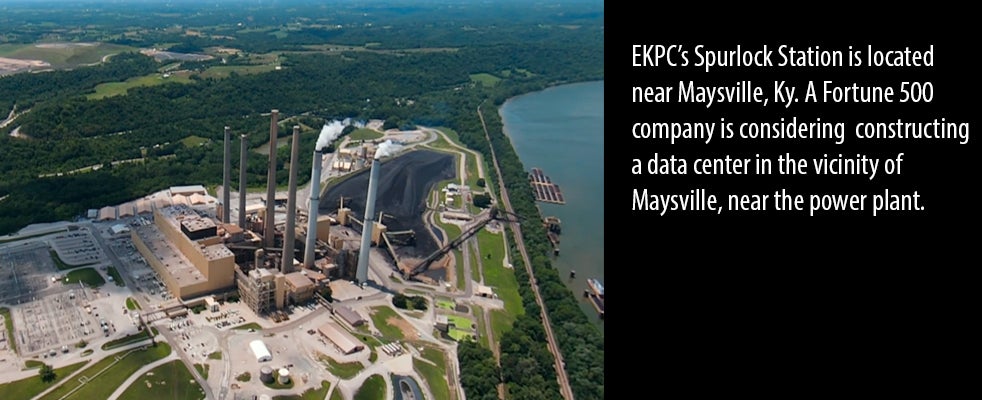
For more than a year, EKPC has been in talks with a Fortune 100 company—an organization with a globally recognized brand name—regarding energy needs for a site it is considering in the vicinity of Maysville near EKPC’s Spurlock Station power plant. We have discussed serving various levels of power usage, and options for meeting that need. It could require building new power plant capacity in Kentucky. It might require purchasing electricity from elsewhere under a long-term arrangement. It could require a combination of both.
Currently, there is available excess capacity on the regional transmission grid to accommodate a large load in the Maysville region with moderate additions of high-voltage transmission infrastructure. The data center would be responsible for paying all of those costs, under EKPC’s rate schedule. That extra transmission capacity likely will disappear if a different data center locates elsewhere in this portion of the regional transmission organization (RTO), such as in southern Ohio. If that happens, cooperative members here in Kentucky will see no benefits from rate stabilization, nor from local jobs, tax base, etc. If another prospective large load showed up later, infrastructure additions needed to support them may be more expensive, since the available capacity has been reduced by the neighboring state.
EKPC has plans to build new generating resources, including a new unit at Cooper Station in Somerset and a new power plant in Casey County. However, those are for the current and growing energy needs of our existing cooperative members. A large new load will need new resources.
By owning reliable power plant capacity and participating in an RTO, EKPC is ensuring reliable, competitively priced service for Kentucky’s homes and businesses while maintaining flexibility to meet unique needs of large loads.
EKPC and PJM
EKPC is a member of PJM Interconnection, an independent, non-profit RTO that coordinates the flow of electricity in 13 states and the District of Columbia. PJM’s top priority is maintaining grid reliability. It strives to do that using competitive market tools.
The power plants and power lines are owned by EKPC and by similar entities throughout the region. PJM coordinates the generation and movement of electrons. When a new power plant or large new consumer is planned, PJM conducts studies to identify transmission constraints, and requires upgrades when necessary.
PJM also operates electricity markets where EKPC and hundreds of other organizations buy and sell energy and power plant capacity. Because PJM is the largest power market in the U.S., and its footprint encompasses major population and commercial centers in the mid-Atlantic region, data center developers want to be located in the region.
PJM does not set rates. It provides access to a market, where prices are established based on supply and demand. Because EKPC owns enough reliable power plant capacity to cover all of its members’ needs under most circumstances, it is rarely exposed to unhedged market prices. In fact, EKPC is a net seller of capacity in PJM, while many other states must purchase their capacity. Those states that pursued policies to shut down reliable power plants and expose their citizens to the market now are complaining the loudest about high prices in PJM.
As long as our policy-makers continue supporting reliable power plant capacity here in Kentucky, and data centers are willing to pay their way, EKPC and our 16 owner-members can serve the energy needs of these facilities while ensuring continued low rates for Kentucky’s homes and businesses.
Maintaining local control – and winning!
Data centers will be built. If they are not built here in Kentucky, then they will go to nearby states. When that happens, the value they can provide to our communities goes with them. The transmission grid improvements and new locally built generation go, along with the benefit of increased reliability of Kentucky’s electric grid.
Surprisingly, Kentucky’s electric customers could see costs if the data centers go to a nearby state. Electrons flow in ways that can create congestion on our electric grid. Under PJM’s federally approved transmission tariff, the costs of new transmission infrastructure can be spread to adjacent transmission owners like EKPC. If the facility is not located in Kentucky’s electric cooperative territory, then it is not subject to EKPC’s rate schedule, which would assign those costs to the data center. So Kentucky residents could be left paying a portion of the transmission costs while the value goes to other states. As a result, data centers’ transmission investments and siting new generation outside of Kentucky can create unpredictable and significant costs that we cannot control.
Local control is indeed important.
Kentucky is the proud home of winners. Whether on the basketball court, or at Churchill Downs and Keeneland, Kentucky is home to winners. Serving and hosting data centers, if done prudently and wisely as EKPC is committed to, our 16 owner-members will win, bringing and keeping value here in our communities.
---
Don Mosier is president & CEO of East Kentucky Power Cooperative (EKPC), which supplies electricity for 16 electric cooperatives serving 1.1 million Kentucky residents across 89 counties.